
9. X-Pigeons |
||||
~ PIGEON COLORS 1 ~
 Studying
genetic science is like peeling an onion. We can take an onion
and study it from outside as much as we want thinking we figured
out everything and understand everything there is to know about that
onion. When we dare to peel off the first layer, or when we have
the technology to peel off that first layer to study, as pertaining
to the study of genetics, we would find that the new layer we just
exposed has a surprise we did not see by looking at the previous
layer. Every successive layer could easily disprove well believed
theories. In fact, more than likely each new layer we peel off will
give us a new surprise. Studying pigeon genetics, solving the puzzle
of pigeon genes and their inheritance is like peeling an onion, one
layer at a time. The difference is
with
an onion
there is a final layer; in science it might take
years for us to reach that final discovery in most aspects of genetic
science.
Studying
genetic science is like peeling an onion. We can take an onion
and study it from outside as much as we want thinking we figured
out everything and understand everything there is to know about that
onion. When we dare to peel off the first layer, or when we have
the technology to peel off that first layer to study, as pertaining
to the study of genetics, we would find that the new layer we just
exposed has a surprise we did not see by looking at the previous
layer. Every successive layer could easily disprove well believed
theories. In fact, more than likely each new layer we peel off will
give us a new surprise. Studying pigeon genetics, solving the puzzle
of pigeon genes and their inheritance is like peeling an onion, one
layer at a time. The difference is
with
an onion
there is a final layer; in science it might take
years for us to reach that final discovery in most aspects of genetic
science.
Although many scientists are skeptical about the contributions that studies of pigeons can make to science, from laboratory studies, scientists have discovered a lot about pigeon anatomy, physiology, and genetics in the last century. Pigeons are usually the species of choice for studying bird flight, homing instincts, navigational abilities, intelligence, and self-cognitive abilities. However, despite their worldwide occurrences and unique ecological characteristics in nature; their existence as 300+ different domesticated breeds have been vastly ignored by the scientific community for awhile, especially after the Hollander Era. With the help of the genome sequencing technology, it seems scientists are back to using pigeons for their choice of species, once again.
Attacking the genetic problems at the biochemical level after the Hollander Era has already started to pay off for pigeon genetics, where three Universities in the US alone are working on sequencing the pigeon genome. Most notably Daniel A. Smith at Goshen College, Indiana, Trey Fondon at University of Texas, Arlington, and Michael D. Shapiro at University of Utah, in Salt Lake City. With the start of the Genomic Era in pigeon genetics, results found in testing tubes in labs are already proven to be much more accurate than conventional Mendelian results. With the advent of molecular biology and biochemistry, biologists, chemists, and geneticists have been forced to start discovering the future progress in understanding exactly what causes different mutant affects in lab studies, instead of the breeding lofts. Therefore, pigeon breeders are encouraged to find and characterize new mutations which cannot be done in laboratories, at least not just yet. Sequencing the pigeon genome will answer many of the questions we simply can’t get by looking at breeding results.
We knew for years that pigeons show a staggering amount of variation within a single species. Unfortunately, most people are interested in learning more about the genes that control color diversity in pigeons, ignoring the differences between the other phenotypic traits, skeletal structure, physiology, and behavior. Yet, in spite of the years of study of the inheritance of color, there are still many colors the inheritance of which is almost entirely unknown. In addition, there are many colors and varieties in pigeons, which often times blended together, that make it almost impossible to enumerate them all. The inheritance becomes complicated by the great number of mutations in the domestic pigeons and their different interactions. In some cases, the effects of two entirely distinct factors may overlap and closely resemble each other. Furthermore, fans of different breeds and breeders from different parts of the world call each color different names, which creates even more confusion in terminology. Instead of labeling the expression of each gene (mutation) on the “wild-type” plumage, they apply names to gene combinations - often producing confusion. Nonetheless, laypeople can and do make very important contributions to various areas of science today. Thanks to careful and serious pigeon breeders everywhere in the world, ever since the rock dove was domesticated, we keep finding and developing new breeds and colors. Observing the details and writing those observations down in records can be very important starting point data for experts. Most of the times, pigeon breeders do not collect data and write down their observations. As far as the science is concerned, if the observations are not written down, they do not exist. Claims without data, without basis, are meaningless and will be ignored by the experts. Therefore, I like to encourage every pigeon breeder to keep good records of their birds, write down their observations, and keep contributing to this great hobby of ours as we continue to enjoy breeding and flying pigeons.
Until quite recently we thought that alleles were limited in numbers, but with DNA sequencing we have learned this is far from the truth. Since a gene can be changed to alternative forms by the process of mutation, a large number of alleles is theoretically possible in a population of individuals. Whenever more than two alleles are identified at a gene locus in a population, we have a multiple allelic series. Therefore, genetics is very rapidly becoming vastly more complex than anyone dreamed it was a few years ago. Because the advent of yeast molecular genetics has introduced new and exciting capabilities a real understanding of genetics is getting too hard for laypeople to grasp in detail. The bigger confusion is the fact that majority of pigeon keepers and breeders still think that pigeons have three base colors (blue, brown, and red), and they are therefore badly confused.
 Color
and pigment are two different things. Many
pigeon breeders misuse the words “color” and “pigment” and
they are convinced that pigeons have three basic or base colors.
The truth is pigeons are able to produce three pigments in their
feathers. Pigmentation is how the light observes the pigment granules
inside the cells.
Pigment is the physical things (melanin) in the feather that
produces "color". We now know that there are at least three
pigments found in pigeons' feathers: brown / black / red and these
are all different chemical forms of melanin that are deposited in
their
feathers.
According to
Dr. Richard Cryberg, black and brown are both eumelanin pigments.
Brown is the result of failure of the very last oxidation step before
the small molecules are polymerized to make pigment. Red is pheomelanin pigment.
Red results from a very slow oxidation in the third small molecule
step due to low tyrosinase activity giving time for the
amino acid cysteine to add to the molecule produced in the second
small molecule step. Thus the fork in the path of pigment synthesis
that leads to red pigment happens quite early and is due to poor
tyrosinase activity while the fork that leads to brown pigment happens
very late in the small molecule pathway and has nothing at all to
do with tyrosinase activity. In the whole plant
and animal kingdom, these are the only melanistic pigments known.
They are widely conserved in the plant and animal kingdoms. Color on the
other hand, can have many variations of literally hundreds of different
colors in pigeons and can be changed by many factors - sun bleaching
of the feathers; any of the various modifying mutations, e.g., dilution,
dirty, smoky, etc.
Color
and pigment are two different things. Many
pigeon breeders misuse the words “color” and “pigment” and
they are convinced that pigeons have three basic or base colors.
The truth is pigeons are able to produce three pigments in their
feathers. Pigmentation is how the light observes the pigment granules
inside the cells.
Pigment is the physical things (melanin) in the feather that
produces "color". We now know that there are at least three
pigments found in pigeons' feathers: brown / black / red and these
are all different chemical forms of melanin that are deposited in
their
feathers.
According to
Dr. Richard Cryberg, black and brown are both eumelanin pigments.
Brown is the result of failure of the very last oxidation step before
the small molecules are polymerized to make pigment. Red is pheomelanin pigment.
Red results from a very slow oxidation in the third small molecule
step due to low tyrosinase activity giving time for the
amino acid cysteine to add to the molecule produced in the second
small molecule step. Thus the fork in the path of pigment synthesis
that leads to red pigment happens quite early and is due to poor
tyrosinase activity while the fork that leads to brown pigment happens
very late in the small molecule pathway and has nothing at all to
do with tyrosinase activity. In the whole plant
and animal kingdom, these are the only melanistic pigments known.
They are widely conserved in the plant and animal kingdoms. Color on the
other hand, can have many variations of literally hundreds of different
colors in pigeons and can be changed by many factors - sun bleaching
of the feathers; any of the various modifying mutations, e.g., dilution,
dirty, smoky, etc.
Now,
let us look at the three colors pigments
pigeons are able to produce in their feathers. After all, rest of
the colors and variations come from these three pigments or their
combinations. For instance,
the blue and red colors we see on an indigo phenotype are produced
by combination of black and red melanins. The melanin producing
an ash-red phenotype is the same melanin used producing recessive
red phenotype.
However, we know that both indigo and recessive red are not sex-linked
genes and located in autosomal chromosomes. Therefore, it would
be wrong to think the red found in the ash-red phenotype is one of
the so-called three base colors. After all, ash-red is not a color,
but a phenotype produced by red and black pigments. Thus, it would
be less confusing to say that one of the three pigments pigeons are
able to produce in
their feathers is red. Genetic science proves for sure that
pigeons are
able
to produce three different pigments in their feathers, which are red, black,
and brown; but this doesn’t
mean they are the three base colors.
It would be acceptable to say pigeons have one or more of the three pigments deposited in their feathers, but saying all pigeons are one of the three base colors is simply wrong because this idea implies that there is something special about brown and ash-red compared to other mutations like recessive red, recessive white, indigo, etc.
The color blue and black can also be confusing and very often misused by pigeon fanciers. If we take a blue bar bird and look at its bluish looking feathers under a microscope, we would see mostly "black" linear shaped granules. The pigment color in reality is black, but we see it as blue because of the way melanin in the pigments observes the light. However, because the bars are black in color, but most of the feathers appear to be blue, Willard F. Hollander called it "Blue/Black". Unfortunately, this terminology sometimes lead people to believe that blue pigment exist and some breeders even think there is a blue gene. How do we get a blue/gray phenotype from black pigments? According to Dr. Axel Sell, we get blue birds when the black pigment is produced in limited quantities and this limited quantity of pigment is also not uniformly distributed like in the bars and in the sub-terminal tail band. When examined under a microscope some areas (under wings and rump) of blue birds have no visible pigments at all.
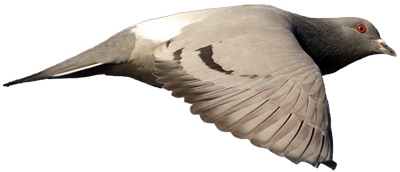 Recall
that to make a pigeon that is wild-type in every loci is
almost impossible since mutations are not preventable. When comparing
a mutation, to a wild-type, we will consider
that there is a wild-type gene at the locus we are testing that particular
mutation. In order to have a wild-type -- Columba livia that is free
of all the possible mutations, all the wild-type genes must be present
and function correctly to make a fully wild-type phenotype. Any gene
that is not performing normally because something happened to it
that
changed as little as one single codon is called a
mutant gene. The black pigment
found in blue bar pigeons is considered to be the wild-type, the standard
against which we judge
everything in pigeon
genetics for plumage color. So, the blue looking
pigeon with black bars on its wings, which we generally refer as
the blue bar phenotype, is our wild-type. The genes that make that
bird a blue looking bird and giving the same bird the bar pattern
(as opposed to checker or barless patterns) are controlled by different
genes.
Recall
that to make a pigeon that is wild-type in every loci is
almost impossible since mutations are not preventable. When comparing
a mutation, to a wild-type, we will consider
that there is a wild-type gene at the locus we are testing that particular
mutation. In order to have a wild-type -- Columba livia that is free
of all the possible mutations, all the wild-type genes must be present
and function correctly to make a fully wild-type phenotype. Any gene
that is not performing normally because something happened to it
that
changed as little as one single codon is called a
mutant gene. The black pigment
found in blue bar pigeons is considered to be the wild-type, the standard
against which we judge
everything in pigeon
genetics for plumage color. So, the blue looking
pigeon with black bars on its wings, which we generally refer as
the blue bar phenotype, is our wild-type. The genes that make that
bird a blue looking bird and giving the same bird the bar pattern
(as opposed to checker or barless patterns) are controlled by different
genes.
The rules of genetic science are very strict and they don’t allow us to label genes that we consider to be part of the wild-type genome - all of them are symbolized with "+". Therefore, we cannot label "+" as a "bar" and "blue" (as opposed to brown or ash-red) with a +. It is imperative to understand that the single + symbol cannot represent the genes that make the bird appear as the wild-type phenotype. In other words, each trait is controlled by a different wild-type (+) gene(s). For instance, in pigeon genetics e represents the recessive red mutation. Therefore, if we say a bird is e//+, it indicates the bird is heterozygous for recessive red but it certainly does not mean that the bird is "blue" or "bar", nor does it indicate that the bird is heterozygous for blue or bar; e//+ only indicates that this bird is heterozygous for recessive red only at the recessive red locus. The wild-type concept is very tough concept for those trying to understand the significance of wild-type, but it is extremely important concept to learn when studying genetics. What most people don’t quite understand is that there is a wild-type gene in every locus and not just at the b locus where ash-red and brown mutations are located.
Take the indigo locus as another example. To get a wild-type phenotype, both alleles at the indigo locus must have the wild-type genes. When the wild-type gene at indigo locus is mutated (In//+ or In//In), the biochemistry of producing pigments is diverted and produced a different phenotype than the wild-type phenotype, even if the genes at the sex-linked b-locus are still coding for wild-type. In fact, since indigo is an autosomal dominant gene, it must do something biochemically that the wild-type gene coding cannot do at the indigo locus. So far, no one knows how many genes are involved in making a blue barred bird, but we know for sure it is a lot more than simply one gene. So the question boils down to what genes modulate the amount of pigment produced and govern, and how this limited amount of pigment is deposited in the feathers to produce what we all call a blue bar phenotype? We really can’t get an accurate count as genes mutate all the time. As many biological processes are due to multiple genes it is perfectly reasonable that more than one is responsible for the combination of amount and distribution of pigment. Therefore, all the known genes affecting the feather colors from an otherwise blue looking pigeon is part of this total number of genes involved in making a wild-type Columba livia e.g. indigo, recessive red, recessive white, dilute, reduced, almond series, albino, spread, milky, recessive and dominant opal, dirty, sooty, smoky and the list goes on. You can add to this list any other locus where we have a mutant which modifies either the amount of pigment produced or impacts how the pigment is distributed in the feather microscopically. There also could very well be others where we simply have never isolated a mutant so do not even know a gene is present.
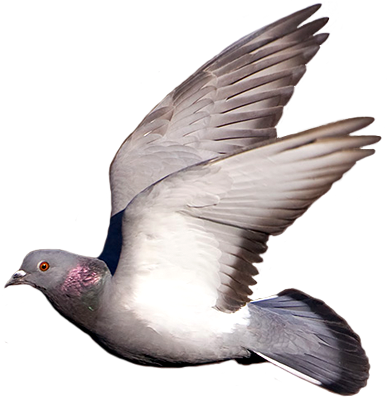 According
to Dr. Richard Cryberg, the bucket brigade analogy has often been used
in explaining biopathways of melanins. A starting material is dumped
into bucket one and modified by whatever locus is associated with bucket
one. Then bucket one is dumped into bucket two and the locus associated
with bucket two does its thing. Then bucket two is dumped into bucket
three, and on and on until you get to the final bucket and dump out
the final product. Change in activity
of any locus associated with any bucket and a different final product
comes out of the last bucket or perhaps the same product but in different
amounts. That is why we have so many color varieties such as indigo,
dilute, pale, reduced, milky, platinum, almond, recessive red and
on and on. Each of those genes controls what happens in one
particular
bucket in the biosynthesis pathway. When all buckets are wild-type
you get a blue bar phenotype.
When any one bucket is different from wild-type you may get something
different from wild-type if the change is big enough to impact the
biochemistry.
According
to Dr. Richard Cryberg, the bucket brigade analogy has often been used
in explaining biopathways of melanins. A starting material is dumped
into bucket one and modified by whatever locus is associated with bucket
one. Then bucket one is dumped into bucket two and the locus associated
with bucket two does its thing. Then bucket two is dumped into bucket
three, and on and on until you get to the final bucket and dump out
the final product. Change in activity
of any locus associated with any bucket and a different final product
comes out of the last bucket or perhaps the same product but in different
amounts. That is why we have so many color varieties such as indigo,
dilute, pale, reduced, milky, platinum, almond, recessive red and
on and on. Each of those genes controls what happens in one
particular
bucket in the biosynthesis pathway. When all buckets are wild-type
you get a blue bar phenotype.
When any one bucket is different from wild-type you may get something
different from wild-type if the change is big enough to impact the
biochemistry.
W. F. Hollander thought that the pigment which provides the coloring in pigeons came in two different arrangements. In the bars, pigment was spread out. In the rest of the feather it was clumped. Where the pigment is clumped, more light is bounced back to us and we see a blue-gray color instead of black. This pigment arrangement of bars and body showing a different color is the normal situation in the wild-type (blue bar) pigeons.
However, our recent discoveries conducted by Dr. Cryberg suggest that physical distribution of the pigment granules are not clumped or spread when feathers are observed under a microscope. The pigment in the sub-terminal tail bar is quite different than that in the rest of the bird. The granules in the tail bar of a typical blue bar are way smaller than in the rest of the bird. They are also very, very numerous. There simply is a lot more total pigment. The spread mutation takes whatever is happening in the tail bar and makes it happen on the whole bird.
According to a study done by Haase E., Ito S., Sell A., et al., (1992) “Melanin Concentrations in Feathers from Wild and Domestic Pigeons,” Journal of Heredity, "all" pigeons have both eumelanin (black or brown) and pheomelanin (red) pigments in their feathers. Yes, you’ve read it correctly - ALL pigeons, regardless of how they appear to our eyes have both eumelanin (black or brown) and pheomelanin (red) pigments in their feathers. This study suggests that ash-red mutation in homozygous, heterozygous, and hemizygous states drastically reduces the eumelanin (black and brown pigment) content of some parts of the feathers and increase the pheomelanin (red pigment) concentration of the bars and ash areas. The brown mutation seems less effective than ash-red in altering pigment contents. In brown mutants, the eumelanin concentration is reduced compared to wild-type value, and pheomelanin concentration in the bars is increased. In addition, this study suggests that the spread mutation (S) on blue/black series leads more or less complete disappearance of the bars. The differences in pigment concentration between the slightly dark distal and the lighter proximal parts of the feathers of S-bearing birds are small in relation to the difference of a blue bar pigeon. Spread mutation increases the eumelanin concentration of the blue bar's feather to or slightly above the level found in the bars. At the same time, pheomelanin levels are depressed in blue bars. When an ash-red is combined with spread mutation, it shows no changes in the pheomelanin level and a slight increase in the eumelanin concentration. However, spread severely depresses pheomelanin concentration in ash-red phenotypes. Surprisingly, when spread (S) mutation is combined with a brown mutant, the high pheomelanin level in the bars is strongly reduced by spread mutation. When this study examined the levels of melanins in spread indigo (andalusian) feathers, the eumelanin concentration of the vanes is reduced in the andalusian to one-half to one-third, which corresponds with the visual impression of the plumage (black vs. blue/black). In this genetic constellation pheomelanin levels seem not to be affected by indigo mutation.
Furthermore, this study also suggest that both ash-red and recessive red are due to pheomelanin pigments although recessive red puts more pigment in the feather than ash-red does. This result is reached by reducing the eumelanin level of the vane to values found in the clumping area of the wild-type and by a high elevation of the pheomelanin content to and slightly above the concentration found in the red bars of ash-red birds. Although, the numbers provided for eumelanin and pheomelanin degradation products in this study cannot be directly compared, this study allows us to make some reasonable guesses based on how the degradation products relate to actual eumelanin and pheomelanin ratios. This study proves that blues and blacks have very little red pigment while bronzes and reds have many times more red pigments in their feathers. Therefore, although in this study not all the mutations affecting the pigment production on the feathers are examined, this study is a good enough proof that all pigeons produce some of both eumelanin and pheomelanin in their feathers. In other words, pigeons have one or more of the three pigments deposited in their feathers. Therefore, to think pigeons have so-called three base colors which are only produced on the feathers of ash-red, blue/black (wild-type), and brown birds is wrong and misleading.
Recall that we rate every mutation versus a standard and we can only test the alleles and compare them to each other. Thus, we can’t compare ash-red with an indigo because they are not alleles. The standard when testing blue/black, ash-red, and brown is blue/black (wild-type). Therefore we say ash-red is dominant to wild-type and brown is recessive to wild-type. It would be wrong to say wild-type (blue/black) is dominant to brown and recessive to ash-red, because it is our standard, the unknown. Breeding data suggest that ash-red is dominant to brown or brown is recessive to ash-red. Sometimes the word dominant is misunderstood. A dominant allele is not necessarily better or stronger than a recessive allele. It does not necessarily occur most often in the population. An allele is dominant in heterozygote simply because it is expressed and the other allele is not.
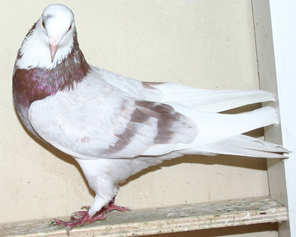
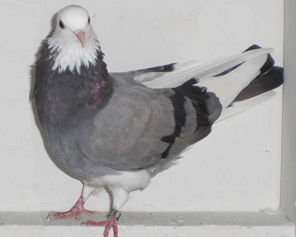
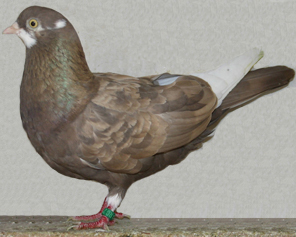
In the above pictures, I have used my Birmingham Rollers to demonstrate the alleles of the b locus genes which are located on the Z sex-chromosome. The blue/black is the wild-type version of the genes and brown and ash-red are the mutated alleles of this wild-type gene at the b locus. Notice the order of the colors from dominant to recessive: ash-red, blue/black (wild-type), and brown. Because of the b locus we get our symbol for BA for ash-red, capital B indicating the dominant allele of the b locus and A for ash-red. Lower case b for brown is indicating recessive gene of the b locus. We use B+ for blue/black, where the + is unknown wild-type.
Blue/Black
Let’s start with black pigmentation produced by our wild-type, the standard. Notice the main pigment found in the feathers are black, but we call it "blue" when we refer to their phenotype. When we look at the neck and front chest of a blue/black bird, we see a green/purple iridescence (displaying a spectrum of colors) caused by the structure of the feather. Male pigeons tend to show more of this iridescence than females. There is also a sub-terminal tail bar about a quarter inch (6 mm) from the end of the tail. The outer tails in the blue/black based birds (except in spread) also have albescent strip, thin white strip clearly visible running from the base of the feather to the tail bar. The blue bar pattern gets its name from two black bars which cross the wing toward the back. Here is a great description of black pigmented "Blue Bar" phenotype by Ronald Huntley:
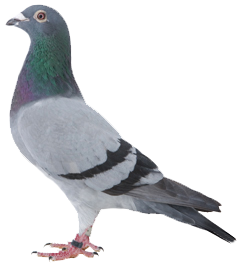 "When
we look at a blue bar pigeon we clearly see what appears as two colors,
that is light bluish gray and black. However, is that what really
exist there in the feathers? Answer NO. All the pigment found on
a blue pattern pigeon is black melanin and it occurs in the form
of rod-shaped granules placed parallel to the long axis of the feather
barbules. The way these rod shaped granules are arranged, determines
the amount of light that is allowed to reflect back to the viewer's
eye. The more light absorbed the darker the image. On the other hand,
the more light reflected, the lighter or in this case, the more bluish
gray that the color appears to our eyes."
"When
we look at a blue bar pigeon we clearly see what appears as two colors,
that is light bluish gray and black. However, is that what really
exist there in the feathers? Answer NO. All the pigment found on
a blue pattern pigeon is black melanin and it occurs in the form
of rod-shaped granules placed parallel to the long axis of the feather
barbules. The way these rod shaped granules are arranged, determines
the amount of light that is allowed to reflect back to the viewer's
eye. The more light absorbed the darker the image. On the other hand,
the more light reflected, the lighter or in this case, the more bluish
gray that the color appears to our eyes."
To call a mostly grey looking bird with black bars as “blue” sure came as a surprise to me when I first heard the term. However, that is the term we use and we will continue to use it since it is the accepted name in the pigeon community. Most laypeople often refuse to follow the biology rules, which make the biologist and the geneticist pretty annoyed. Lots of pigeon people are 100% convinced that there is a gene named the blue gene. Blue color phenotype is the wild-type in pigeon genetics and the biologists’ rules are very specific that wild-type genes can never be named for a phenotype. Thus to call a gene "the blue gene" violates this rule and will confuse the heck out of any biologist as he/she thinks you are talking about a mutant from wild-type. Basically, we are not allowed to give phenotypical name to wild-type since it is our standard. That means we cannot call wild-type at the ash-red locus “blue gene” or "black gene" because it is simply wild-type whatever locus we are talking about. However, if we are referring to the color (phenotypic expression) of the pigment we can use the word blue or black, but not about the gene itself. The wild-type phenotype is the standard which we compare every other mutation and black is the only base color because of that. Base is another way of saying standard of comparison if that helps you understand the argument.
Another common confusion among breeders is that when we talk about the standard (wild-type), most people automatically think about blue bar, which is fine. However, we are discussing color here, and not the pattern, and therefore blue check, blue T-check and blue barless phenotypes are caused by the same wild-type gene located at the b-locus. The genes located at the c locus that controls the pattern doesn’t change the fact that blue/black is our standard color no matter what pattern is affecting its phenotype. In the case of spread, which is not part of the pattern series but caused by another gene located in another locus, also represents our base color since the gene controls the pigment color is still producing black pigments. When we are testing the dominance or recessiveness of blue/black to ash-red or brown, we can use any pattern, even a spread for testing, since the trait we are testing is color, not the pattern. Same goes for blue grizzles, and all the piebalds that are either blue or black.
Ash-red
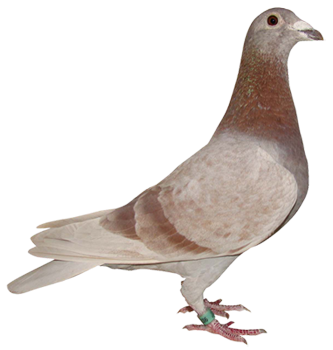 In
an ash-red phenotype the wing bars appear to be brick-red color on a
clear silver body, and the tail bar is not clearly visible. The otherwise
bluish "ground" color we observe on wild-type is gray-like
with reddish tones in ash-red phenotype. When we look at an ash-red pigeon,
we should notice neither wing bars nor tail bar is the same color as
it is on a wild-type (blue/black) bird. The sub-terminal tail band in
ash-red pigeons has been washed out to an ashy-gray color. On the other
hand, a blue bar or brown bar has a positive tail
bar; that is a tail
bar more pigmented than the rest of the tail. An ash red has a negative
tail bar; that is a tail bar with less pigment than the rest of
the tail.
In
an ash-red phenotype the wing bars appear to be brick-red color on a
clear silver body, and the tail bar is not clearly visible. The otherwise
bluish "ground" color we observe on wild-type is gray-like
with reddish tones in ash-red phenotype. When we look at an ash-red pigeon,
we should notice neither wing bars nor tail bar is the same color as
it is on a wild-type (blue/black) bird. The sub-terminal tail band in
ash-red pigeons has been washed out to an ashy-gray color. On the other
hand, a blue bar or brown bar has a positive tail
bar; that is a tail
bar more pigmented than the rest of the tail. An ash red has a negative
tail bar; that is a tail bar with less pigment than the rest of
the tail.
It is imperative to notice that when ash-red is combined with the spread mutation, the entire bird is gray or ashy color with only very faint red showing. When a wild-type is combined with the spread mutation, we get a spread black phenotype, or when brown is combined with the spread mutation we get a chocolate color phenotype. So, why doesn’t ash-red when combined with spread look like brick red, instead of the ashy gray?
Because spread mutation does whatever the sub-terminal tail band does, in all over the bird. In other words, however the pigments are produced and physically distributed in the tail band, the spread does the same thing in all of the feathers. Therefore, when ash-red is combined with spread, the entire body takes the color of the sub-terminal tail band. In ash-red birds, the tail bar and the albescent strip are very difficult if not impossible to see clearly. Initially the term dominant red was used for the ash-red mutation but W. F. Hollander wisely chose the name ash-red, because of the characteristic washing out to ashy or ashen coloration associated with the gene. Ash-reds wash-out to gray (ash) towards the tail and ends of the flight feathers. This so-called “mark of the ash” is reliable identification clue of ash-red phenotype.
The breeding data suggest that ash-red is a sex-linked dominant mutation. Heterozygous ash-red males carrying wild-type or brown at b-locus will show black or brown flecks in their phenotype especially in the tail and flights even when they are very young. So, if you see such an ash-red pigeon with dark flecks, more than likely it is a male. Males heterozygous for ash-red and brown have brown flecks. Conventional pigeon genetics from the Hollander era suggest that brown or black flecking in ash-red can only happen to male ash-red birds that are split for either wild-type or brown. However, it is quite common for hen ash-reds to produce black flecks. Or flecks that are a mix of red and black pigments. In fact, a hen ash-red that is able to produce brown pigment is a very rare case, but such hen does exist. So, we have two types of ash-red hens. Some of them are able to make black pigment and a very tiny number are able to make brown pigment.
Now, you should be asking if ash-red and brown were alleles and since hens only have one functional sex-chromosome (Z), how could they have two mutated genes (ash-red and brown) at the b-locus at the same time? Hmmm….is there more than one brown gene located somewhere else in the sex-chromosome? Perhaps flecks are caused by some other genes?
The term ash-red is used for many variations of colors and patterns that are somewhat similar in appearance, but very different phenotypically. Patterns in ash-red involving distribution of pigment are the same as in blue-black. Although phenotype is called ash-red, keep in mind that the actual pigment is red. Ash-red bar sooty is often called mealy by racing fanciers. Ash-red bar is often called "silver" by roller breeders. Ash-red spread is called lavender or barless mealy (even though in reality the bird is not barless) by many breeders. T-pattern check ash-red with Lebanon bronze modifier is called “ribbon-tail” by many breeders. A red bar pigeon with some white on its head is often called a silver (or mealy) pied by a racing homer breeder but the same colored bird would be known as a silver badge by a Birmingham roller breeder. Why do we have many phenotypical names to ash-red variants? It’s because, pigeon fanciers from different parts of the world, breeding different pigeon breeds described the color and pattern of the birds, and call the phenotype produced by more than one mutation a different name long before their genetics was studied.
The ash-red is produced by mixture of red that consist of a very low concentration of mainly black pigments. Same mixture exist in all bronze phenotypes where all known reds in pigeons also contain black pigments which includes ash red, recessive red, ember, kite, Modena bronze, Arch bronze, indigo, etc. and by definition we call them all bronzes. The black pigment that contributes to make the ash-red appearance has more or less red incorporated into the individual pigment granules. Thus, we see from almost white wing shield ash-reds to fairly bronzy ash-reds in variety of pigeon breeds. In most ash-red hens, the mixture of black and ash-red pigment seems a bit lower overall concentration than normal in a cock bird and generally bronzier than in a cock bird.
There is also recessive red, which should not be confused with the ash-red. Ash red is a dominant color and has its genetic symbol as BA and the recessive red is lower case e indicating the recessive gene. Unlike Ash red, the recessive red is recessive to wild-type. In addition, recessive reds are not sex-linked. It is impoartant to underatand that pigment found in both of these mutants are red. I will talk about the recessive red in the next page.
Brown
Brown
is another pigment that pigeons are able to produce - the mutant
is an allele to ash-red at the b locus of the sex-chromosome. The
genetic symbol
for brown is lower case b,
indicating that it is a sex-linked recessive gene. Brown is recessive
to blue/black
(wild-type). Brown birds
also have dark sub-terminal tail bands and this color is as dark
as the color visible in the bars. This mutation changes the base
color
from
a bluish gray to a brown gray. Unlike the wild-type -- blue/black,
brown pigments fade considerably when bleached by the sun but no
one really
knows
why this is happening to brown pigmented feathers only. After
a month of full sun the brown feather is nearly white. The
outer tails in the brown based birds (except in spread) also have albescent
strip, just like the blue based phenotypes.
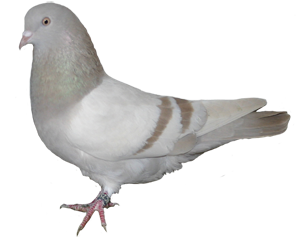
According to Dr. Willard F. Hollander, another very important distinguishing factor is that brown birds always show a false pearl eye which looks duller than the blue/black and ash-red birds. The reason why brown birds show what is known as the false pearl eyes is still unknown. The brown pigment granules in brown birds look like the black pigment found in wild-type, where brown pigment gives us a "silvery" color, but in reality they are brown pigments under a microscope. Spread brown pigment gives us a dark cocoa colored bird. Browns occur in the same patterns as found in blues. The patterns of browns are clear and distinct as in blues. The brown is usually confused with, and known as dun or silver, although brown is genetically entirely different pigment found in pigeons. Under the microscope a dun pigeon is going to have pigment granules way too small to resolve but they will be black. A brown pigeon will have pigment granules of normal size and will have the brown pigment. So the size difference is diagnostic between brown and dilute blue spread. Also, all brown birds show false pearl eye, but this doesn’t mean every pearl eye bird is a brown since a dun bird can also have pearl eyes. In addition, the baby brown chicks are always normal-downed, unlike dun chicks.
So, recapping quickly. Pigeons are able to produce three pigments and they are: red, black, and brown. It is very important to understand that brown is a pigment as is black and red. However, ash-red is NOT a pigment. Ash-red is a phenotype you get by a combination of red pigments deposited in some areas and black pigments deposited in other areas. The idea that there are three colors in pigeons is simply nonsense. There are lots and lots of colors in pigeons. We call them things like dilute and reduced, indigo and recessive opal, recessive red, and dominant opal and of course blue and brown. All of these colors are made from various combinations of three pigments. Those pigments are black, brown and red.
Expected mating results of b locus alleles
At the b locus where the wild-type gene producing blue-black has mutated twice so far - ash-red (dominant to wild-type) and brown (recessive to wild-type). Since these alternatives (alleles) can only fit in one place (locus) on the sex chromosome, then only one of them can be present on any single sex-chromosome. In pigeons, females only have one functional sex-chromosomes (Z and W), where the males have two functional sex-chromosomes (Z and Z). Therefore, a female pigeon can only carry one of the sex-linked genes. In genetics a dot (.) is used to represent a non-functional or empty chromosome known as the W sex-chromosome. Also recall that Z chromosomes never pass from mother to daughter; instead, W chromosomes always pass from mother to daughter.
Therefore, there can only be three possibilities for hens to represent ash-red, wild-type, and brown: ash-red BA/•), wild-type (+/•), and brown (b/•).
On the other hand, at the b-locus, the cocks can be:
- BA//BA - Homozygous ash-red no flecks.
- BA//+ - Heterozygous ash-red carrying blue-black showing black flecks on their phenotype.
- BA//b - Heterozygous ash-red carrying brown showing brown flecks on their phenotype.
- +//+ - Homozygous blue-black (wild-type).
- +//b - Heterozygous blue-black carrying brown.
- b//b - Homozygous brown.
I mentioned above that we are not allowed to give phonotypical names to wild-type genes. There is no gene known as the blue gene, in fact there isn’t even a blue pigment in wild-type. In the following explanations I will use the fanciers’ term and call them by their phenotype: blue hens or blue cocks just to help you understand the basic results of the matings. However, keep in mind that correct terminology when referring to their genotype is wild-type. A male pigeon, for example, can express itself as an ash-red bar in its phenotype. However, this particular bird could have other hidden (recessive) genes like brown, or any number of wild-type genes that together contribute to making blue (wild-type) in its genotype. We simply won’t know what this ash-red cock bird has in its genotype until we compare the mating results. In addition, pigment color found in ash-red’s genotype is red, therefore when we refer to the pigment, we will call it red, but the phenotype this mutation presents is called ash-red.
Homozygous ash-red cock (BA//BA) - Both alleles are ash-red, he has no choice but to donate one of the ash-red alleles during mating. This also means that whichever hen (blue or brown) we mate this cock bird, all the offspring will be expressing ash-red in their phenotype. The male offspring will carry the other allele that they inherited from their mother, but will still express an ash-red phenotype since ash-red is dominant to both blue and brown. all the female offspring from this cock bird will be ash-red.
Homozygous ash-red cock X ash-red hen - All the cock birds will be
homozygous ash-red, all the hens will be ash-red.
Homozygous ash-red cock X blue
hen - All the cock birds will
be heterozygous ash-red carrying blue, all the hens
will be ash-red.
Homozygous ash-red cock X brown
hen - All the cock birds
will be heterozygous ash-red carrying brown, all
the hens will be ash-red.
Heterozygous
ash-red cock (BA//+ or BA//b) -
This means he is carrying two different
alleles at the b locus and one of them is definitely ash-red, as
it is expressed because of its dominance. We don't know what the
other pigment is but it has to be either blue (+) or brown (b). If
you look closely at a heterozygous ash-red cock there will be dark
flecks
in his feathers if he is carrying blue or brown. The other allele
this heretozygous ash-red cock is carrying cannot be ash-red; otherwise
he would be called homozygous ash-red. During mating he can donate
either the ash-red or the other (blue or brown) allelic genes he
is carrying. This means, he may not have ash-red offspring if he
donates the other alleles (blue or brown) that he is carrying. This
may confuse a lot of people if they don't understand the genetics.
Heterozygous
ash-red cock mated to ash-red hen may produce blue or brown offspring
(all the offspring will be hens if they are not ash-red). How? Because
he donated the other gene (blue or brown) he was carrying on his
other functional Z sex-chromosome and the ash-red hen donated the
non-functional (W) chromosome. 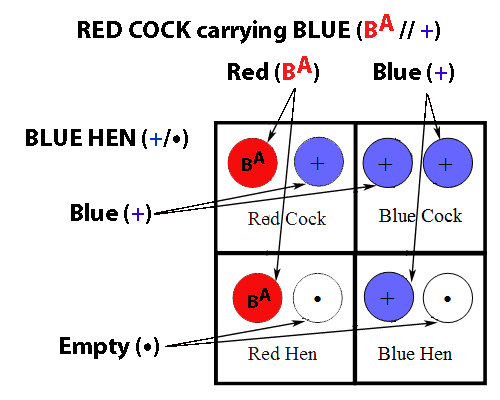
Heterozygous ash-red cock carrying blue X ash-red hen - 50% chance that cock birds will be homozygous ash-red, and 50% of the cock birds will be heterozygous ash-red carrying blue. 50% of the hens will be ash-red and 50% of the hens will be blue.
Heterozygous ash-red cock carrying blue X blue hen - The picture on the right is the Punnett square that shows the four different possibilities of this mating. 50% chance that cock birds will be homozygous blue if both parents donate blue (top right square in the picture). 50% chance that cock birds will be heterozygous ash-red carrying blue if the hen donates blue and the cock donates red (top left square in the picture). 50% chance that hens will be ash-red if the cock donates red and the hen donates empty--non functional sex chromosome (bottom left square in the picture). 50% chance that hens will be blue if the cock donates blue and the hen donates empty sex chromosome (bottom right square in the picture).
Heterozygous ash-red cock carrying blue X brown hen - 50% chance that cock birds will be heterozygous ash-red carrying brown, 50% chance that cock birds will be heterozygous blue carying brown. 50% of the hens will be ash-red, and the other 50% of the hens will be blue. Notice that this mating can produce both blue and ash-red cock and hen offspring. None of the offspring will be brown pigmented in their phenotype, but all the cock offspring will carry brown in their genotype.
Heterozygous ash-red cock carrying brown X ash-red hen - 50% chance that cock birds will be homozygous ash-red, 50% chance that cock birds will be heterozygous ash-red carrying brown. 50% chance that hens will be ash-red, 50% chance that hens will be brown. All the brown offspring produced from this mating will be hens.
Heterozygous ash-red cock carrying brown X blue hen - 50% chance that cock birds will be heterozygous ash-red carrying blue, 50% chance that cock birds will be blue carrying brown. 50% chance that hens will be ash-red, 50% chance that hens will be brown. In other words, all the hens from this mating will either be ash-red or brown, but not blue. All the cocks from this mating will either be ash-red carrying blue, or blues carrying brown. Therefore, all the blue offspring from this mating will be cock birds carrying brown.
Heterozygous ash-red cock carrying brown X brown hen - 50% chance that cock birds will be homozygous brown. 50% chance that cock birds will be heterozygous ash-red carrying brown. 50% chance that hens will be ash-red, 50% chance that hens will be brown.
Homozygous blue cock (+//+) - Both alleles are wild-type; he has no choice but to donate one of the wild-type genes during mating. If he is mated to an ash-red hen, all the male offspring will be ash-red carrying blue and all the female offspring will be blue. If this cock is mated to another blue hen, then all the offspring will be blue (all the cock birds from that mating would be homozygous blue). If this cock bird is mated to a brown hen, then all the offspring will be blue since brown is recessive to blue. From this mating all the male offspring will be blue carrying brown and all the hens will be blue.
Homozygous blue cock X ash-red hen - All the cock birds will be
heterozygous ash-red carrying blue, all the hens will be blue.
Homozygous blue cock X blue
hen - All the cock birds will be homozygous
blue, all the hens will be blue.
Homozygous blue cock X brown
hen - All the cock birds will be heterozygous
blue carrying brown, all the hens will be blue.
Heterozygous blue cock (+//b) - This means he is carrying two different alleles and one of them is definitely wild-type, as it is expressed and the other one has to be brown. The other allele cannot be ash-red; otherwise this bird would not be showing blue/black pigmentation in its phenotype. Remember that ash-red is dominant to blue and therefore will be expressed when it is present in the genotype. During mating this cock bird can donate either the blue or the brown that he is carrying. Again, is it possible for this cock bird to produce brown offspring? The answer is yes, even if he is mated to an ash-red hen. If he is mated to an ash-red hen, all the males will be ash-red carrying either blue or brown, and all the female offspring will be either blue or brown depending on which allele he has donated.
Heterozygous blue carrying brown X ash-red hen - 50% chance that cock birds will be heterozygous ash-red carrying blue, 50% chance that cock birds will be heterozygous ash-red carrying brown. 50% chance that hens will be blue, 50% chance that hens will be brown. All the hens produced from this mating will either be blue or brown. However, all the cock birds produced by this mating will be ash-reds carrying either blue or brown.
Heterozygous blue carrying brown X blue hen - 50% chance that cock birds will be homozygous blue, 50% chance that cock birds will be heterozygous blue carrying brown. 50% chance that hens will be blue, 50% chance that hens will be brown. All the browns produced from this mating will be hens. Rest of the offspring will be blue hens and cocks.
Heterozygous blue carrying brown X brown hen - 50% chance that cock birds will be homozygous brown, 50% chance that cock birds will be heterozygous blue carrying brown. 50% chance that hens will be blue, 50% chance that hens will be brown.
Homozygous brown cock (b//b) - Both alleles are brown; he has no choice but to donate brown during mating. If he is mated to an ash-red hen, all the male offspring will be ash-red carrying brown and all the female offspring will be brown. If he is mated to a blue hen, all the male offspring will be blue carrying brown and all the female offspring will be brown. If this cock is mated to a brown hen, then all the offspring will be brown. A brown cock bird has to be homozygous for brown to express brown in its phenotype since brown is recessive to both ash-red and blue. So, is it possible for this cock to produce brown cock offspring? The answer is yes, but only if he is mated to a brown hen. Otherwise, all the male offspring from this cock will be either heterozygous ash-red carrying brown or heterozygous blue carrying brown. However, all the hens produced from this cock bird will be browns.
Homozygous brown cock X ash-red hen - All the cock birds will be
heterozygous ash-red carrying brown, all the hens will be brown.
Homozygous brown cock X blue
hen - All the cock birds will be heterozygous
blue carrying brown, all the hens will be brown.
Homozygous brown cock X brown
hen - All the cock birds will be homozygous
brown, all the hens will be brown.
Heterozygous brown cock - There is no such phenotype! Brown is recessive to both ash-red and blue and therefore cannot express itself in heterozygous state.